

 By Admin |
 October 24, 2026
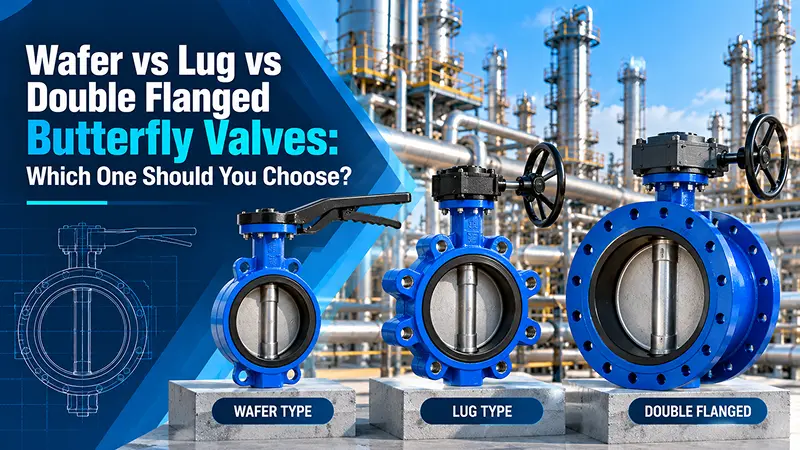
Butterfly valves are popular in industrial piping due to their compact design and quick operation. They help in controlling or isolating the liquid or gas flowing through them in applications such as water treatment, chemical processing, power production and industrial utilities. Jayant Valves offers industrial valve solutions for a wide range of applications, enabling companies to explore their options for their piping needs.
However, not all butterfly valves have the same end connection. Wafer, lug and double flanged designs differ in the way they connect to the pipeline and in the possible maintenance activities. Understanding these differences is important to identify the appropriate product from a Butterfly Valve Manufacturer in India and select the right valve for the operating conditions in the system.
A butterfly valve uses a disc that rotates to open, close or throttle the flow of fluid. It is rotated by a stem that turns a quarter-circle to either open or close the valve.
Butterfly valves are used in many applications due to their space-saving design. Before purchasing the required valve, the buyer needs to determine the required pressure rating, fluid temperature, materials of construction and type of connection.
A wafer butterfly valve is installed between two pipeline flanges. Bolts pass through the flange arrangement to hold the valve in position.
Main Benefits
What to Consider
A wafer valve generally depends on the connected pipeline flanges for installation. It is not normally the right choice when the downstream pipeline must be removed while the upstream side remains pressurised. Always confirm the valve's design and permitted installation conditions.
Wafer valves may suit water lines, utility services and other applications where the connection arrangement meets system requirements.
Lug butterfly valves have threaded inserts or lugs around the body. These allow the valve to be bolted to the pipeline flanges.
Main Benefits
What to Consider
Not all lug valves are suitable for all applications and pressures. Verify the manufacturer’s instructions, pressure rating and installation requirements before using this feature.
Lug valves are commonly used in industrial applications in which equipment needs isolation during inspection or maintenance.
Double flanged butterfly valves have flanges on both ends of the valve body. These flanges are bolted to matching pipeline flanges.
Main Benefits
What to Consider
A double flanged valve may be heavy and may need more mounting space than a wafer design. It is advisable to confirm the face-to-face dimension, flange bolting configuration, pressure rating and clearance.
It is mostly used in large industrial pipelines, water networks and other processes where a flanged body is necessary.
The right choice depends on the piping layout and operating conditions rather than price alone.
Choose a wafer type where the installation is compact and the pipeline flanges can support it. Where the system requires a proper dead-end fitting or needs to be easily isolated for maintenance, the lug type should be considered. A double flanged design can be preferred when a flanged valve body is specified.
Also check the operating pressure, temperature, type of liquid flowing, seat material, actuation method and standards. Consult with the vendor regarding any special requirements before placing your order.
While considering a Butterfly Valve Manufacturer in India, ask for dimension details, pressure rating, materials used and testing. This will help confirm that the valve is right for you.
It is important that the valve design meets the needs of the application and pipeline. The valve's production, material, inspection and assembly all play an important part in its reliability.
Industrial valves from Jayant Valves are made for various types of applications, including butterfly valves. Sharing your project requirements will help you choose an appropriate design instead of choosing a product based on connection type alone.
Each type of butterfly valve has unique advantages when it comes to installation. The choice will depend on the maintenance approach, the connections to be made in the pipeline, operating conditions and project specifications.
If you need industrial piping solutions, contact Jayant Valves. Working with a professional Butterfly Valve Manufacturer in India can help you select the right design.
Copyright © Jayant Valves
Powered by : #1 Vinayak InfoSoft - SEO Company Ahmedabad.